
Focus and Scope
Hasanuddin Law Review (HALREV) is an open-access and peer-reviewed journal that provides an international academic platform for cross-border legal research concerning governance policies and civil rights law, particularly in developing and emerging countries.
The journal welcomes original and substantive legal scholarship, including, but not limited to, the following areas:
- Civil Law;
- Criminal Law;
- Constitutional and Administrative Law;
- Indigenous and Local Knowledge;
- Customary Law and Institutions;
- Religious Law and Jurisprudence;
- International Law and International Legal Regimes;
- Air and Space Law;
- Legal Pluralism and Governance; and
- Other contemporary issues relevant to legal scholarship.
Peer Review Process
The Editor-in-Chief assigns submitted manuscripts to the Managing Editor and relevant editors for initial assessment. Manuscripts that meet the journal's editorial requirements are processed through a double-blind peer-review process, in which the identities of both authors and reviewers are concealed throughout the review process.
The editorial and peer-review workflow is illustrated in the following figure:
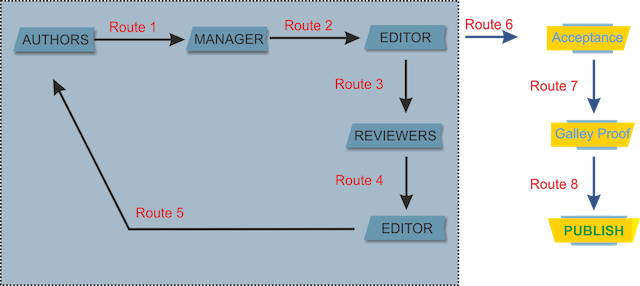
Editorial and Peer-Review Stages
- Manuscript Submission by the author (Route 1).
- Initial Editorial Screening by the Managing Editor and editors (Route 2). The manuscript is assessed for relevance, academic quality, compliance with journal requirements, and originality. Similarity screening using Turnitin is conducted before further editorial processing.
- Peer Review by appointed reviewers (Routes 3–4).
- Editorial Decision based on reviewers' reports. The author may receive a decision of acceptance, revision, resubmission, or rejection (Route 5).
- Revision by the author, where applicable.
- Submission of the Revised Manuscript together with responses to reviewers' comments.
- Where the revision satisfactorily addresses the substantive concerns, the editor may issue an acceptance decision (Route 6).
- The accepted manuscript proceeds to copyediting, production, galley proof, and publication (Routes 7–8).
Editorial Decisions
- Accept: the manuscript is suitable for publication without substantive revision.
- Minor Revision: publication may proceed after relatively limited amendments are satisfactorily completed.
- Major Revision: substantial amendments are required before the manuscript can be reconsidered for publication.
- Resubmit for Review: the manuscript requires fundamental revision and may be reconsidered as a substantially revised submission.
- Reject: the manuscript will not be considered further for publication in its current submission.
Publication Frequency
Hasanuddin Law Review (HALREV) is published by the Faculty of Law, Hasanuddin University, three times a year in April, August, and December.
Open Access Policy
Hasanuddin Law Review provides immediate open access to its published content on the principle that making research freely available to the public supports the wider dissemination and global exchange of knowledge.
Publication Ethics Statement
Allegations of Research Misconduct
Research misconduct includes fabrication, falsification, citation manipulation, plagiarism, and other practices that compromise the integrity of research, peer review, or publication.
When suspected misconduct or serious irregularities are identified, the Editors and Editorial Board of Hasanuddin Law Review will investigate the matter in accordance with recognized publication ethics principles and the best practices recommended by the Committee on Publication Ethics (COPE).
A submitted manuscript found to involve research misconduct may be rejected. Where misconduct is established after publication, appropriate editorial action may include correction, expression of concern, retraction, or other measures necessary to preserve the integrity of the scholarly record.
Where appropriate, the corresponding author will be requested to provide an explanation on behalf of all authors. The journal may also seek clarification from relevant institutions or independent experts.
Duties of Authors
1. Reporting Standards
Authors must present an accurate account of the research undertaken and provide an objective discussion of its significance. Fabrication, falsification, inappropriate manipulation of data, and knowingly inaccurate statements constitute unethical publishing behaviour.
2. Data Access, Retention, and Reproducibility
Authors should be prepared to provide relevant underlying data for editorial review when reasonably requested and should retain research data for an appropriate period after publication. Authors are responsible for ensuring the reliability and reproducibility of their research.
3. Originality and Plagiarism
Authors must ensure that submitted manuscripts constitute original work. All sources and previous publications relevant to the manuscript must be properly acknowledged and cited. Material reproduced verbatim from another source must be appropriately quoted and referenced.
4. Authorship and Contributorship
Authorship should be limited to individuals who have made substantial contributions to the conception, design, execution, analysis, interpretation, or reporting of the research. All listed authors must approve the submitted manuscript and agree to their inclusion as authors.
5. Multiple, Redundant, or Concurrent Publication
Authors must not submit substantially the same manuscript to more than one journal simultaneously. Redundant publication and undisclosed duplicate publication constitute unacceptable publishing practices.
6. Acknowledgement of Sources
Authors must appropriately acknowledge sources of data, ideas, information, and publications that have influenced the reported work.
7. Disclosure and Conflicts of Interest
Authors must disclose financial, institutional, personal, or other relationships that could reasonably be perceived to influence the research or its interpretation. Sources of financial support must also be disclosed.
8. Fundamental Errors in Published Works
Authors who discover significant errors or inaccuracies in their published work must promptly inform the journal and cooperate in issuing an appropriate correction or retraction.
9. Research Involving Human or Animal Subjects
Where research involves human participants, animals, hazardous materials, or sensitive procedures, authors must comply with relevant ethical, legal, and institutional requirements and clearly disclose such matters in the manuscript where applicable.
Duties of Editors
1. Publication Decisions
Editors are responsible for deciding which manuscripts are suitable for publication on the basis of academic merit, relevance, originality, peer-review reports, journal policies, and applicable legal and ethical requirements.
2. Review of Manuscripts
Editors must ensure that manuscripts undergo appropriate initial editorial assessment and, where applicable, independent peer review by reviewers with relevant expertise.
3. Fair Play
Manuscripts must be evaluated solely on their intellectual and scholarly merit without discrimination based on gender, race, religion, nationality, institutional affiliation, citizenship, political belief, or other irrelevant personal characteristics.
4. Confidentiality
Editors must protect confidential information concerning submitted manuscripts, authors, and reviewers and ensure appropriate protection of personal and research data.
5. Disclosure and Conflicts of Interest
Editors must not use unpublished information obtained from submitted manuscripts for personal research or advantage. Editors should recuse themselves from editorial decisions where a relevant conflict of interest exists.
Duties of Reviewers
1. Contribution to Editorial Decisions
Peer review assists editors in making publication decisions and helps authors improve the scholarly quality of their manuscripts.
2. Confidentiality
Manuscripts received for review must be treated as confidential documents and must not be disclosed or discussed with others without authorization from the editor.
3. Acknowledgement of Sources
Reviewers should identify relevant published work that has not been appropriately cited and should inform the editor of substantial similarity, ethical concerns, or suspected misconduct.
4. Standards of Objectivity
Reviews must be conducted objectively. Reviewers should provide clear, constructive, evidence-based comments and distinguish between revisions essential to the validity of the manuscript and those that merely strengthen or extend the work.
5. Disclosure and Conflicts of Interest
Reviewers must not use privileged information obtained through peer review for personal advantage and should decline assignments involving relevant competitive, collaborative, financial, institutional, or personal conflicts of interest.
6. Promptness
Reviewers should accept assignments only when they can reasonably complete the review within the agreed period. Reviewers who cannot meet the deadline should promptly inform the editorial office.
Retraction and Withdrawal Policy
Published articles should ordinarily remain part of the permanent scholarly record. However, exceptional circumstances may require correction, withdrawal, retraction, or other editorial action to preserve the accuracy and integrity of the literature.
Retraction may be initiated by the editors, authors, institutions, or other relevant parties where reliable evidence demonstrates serious error, misconduct, plagiarism, duplicate publication, fraudulent data, inappropriate authorship, or other substantial breaches of publication ethics.
Article Withdrawal
Withdrawal may be considered for manuscripts that have not yet reached final publication, particularly where duplicate submission, authorship disputes, plagiarism, serious ethical concerns, or significant errors are identified.
Authors requesting withdrawal should submit a formal written request explaining the reasons for withdrawal to the Editorial Board of Hasanuddin Law Review.
Article Retraction
Retraction may be applied to a published article where there is reliable evidence of major error, fabrication, falsification, plagiarism, duplicate publication, fraudulent authorship, unethical research, or other serious violations affecting the reliability or integrity of the published record.
Retraction decisions are made by the journal's editors in consultation with the Editorial Board and, where appropriate, relevant authors, institutions, publishers, or other competent parties.
Plagiarism Policy
Hasanuddin Law Review takes plagiarism and self-plagiarism seriously. Submitted manuscripts are subject to similarity screening as part of the editorial assessment process.
A manuscript may be rejected where plagiarism, inappropriate textual duplication, citation manipulation, or other significant originality concerns are identified.
Indexing and Abstracting
Hasanuddin Law Review (HALREV) is indexed, abstracted, or discoverable through the following academic databases and services: